


Geopolitical risk remains elevated: the conflict in Iran continues, and the Strait of Hormuz, a corridor for roughly 20% of global oil and gas flows, stays in focus. Yet, equities keep making new highs. The more interesting question isn’t why markets can rise in the face of uncertainty — it’s what today’s resilience may be signaling about growth expectations, liquidity, and how investors are pricing risk. Let’s dig deeper into the possible reasons.
- AI as a regime shift (or a story that markets are willing to fund)
If markets are even directionally efficient, valuations may be incorporating a step-change in future cash flows from AI-enabled productivity. The key isn’t the buzzword; it’s whether adoption converts into durable margin expansion and broader diffusion beyond a handful of firms. - Policy as an earnings lever
A lighter regulatory stance can raise the market’s estimate of steady-state profitability, often subtly, through faster permitting, lower compliance friction, and increased animal spirits. - Scale is compounding
In an increasingly digital economy, scale advantages can deepen moats, compress unit costs, and concentrate returns. That concentration matters for index composition, factor exposures, and the breadth of leadership. - Risk is being priced with a short memory
Long stretches of strong returns can train investors to expect shallow drawdowns. When recency bias sets the discount rate, macro risk can look cheaper than it is. - Sentiment still matters
Late-cycle behavior often shows up as narrative dominance — capital chasing the label rather than the fundamentals. The question is not whether enthusiasm exists, but whether it is broadening participation or simply inflating a narrow set of winners. - The supply-side tailwind may be fading
The last several years have benefited from constructive supply dynamics (e.g., energy innovation, post-pandemic normalization, and fewer major disruptions). Any reversal, either energy, labor, logistics, or geopolitics, would pressure the “soft landing” narrative. - Liquidity can create its own reality… until it doesn’t
Large deficits and abundant liquidity have coincided with a historically high share of household wealth in equities. Rising prices can reinforce perceived wealth and invite additional risk-taking, creating a reflexive loop and fragility if conditions tighten. Figure 1 highlights the post-2020 increase in the share of household assets held in equities.
Figure 1:
Households and Nonprofit Organizations:
Directly and Indirectly Held Corporate Equities as a Percentage of Financial Assets
October 1, 1945 – October 1, 2025
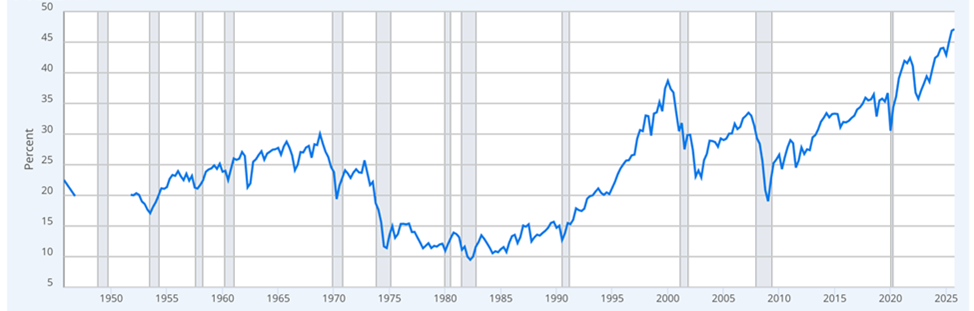
Source: Board of the Governors of the Federal Reserve System
Implications for Intech’s Models
What does this mean for Intech’s models? Directly, not much. Our process has rarely (if ever) depended on a persistent market-beta call. Indirectly, it matters a great deal. Regime shifts — whether driven by AI, policy, liquidity, or geopolitical supply constraints — change the map of correlations, dispersion, and the transmission of risk.
That, in turn, affects where alpha may emerge, how signals behave out of sample, and which exposures we should explicitly control in portfolio construction. Our job is to separate durable structural change from temporary narrative and keep evolving the research agenda to improve our ability to identify potential sources of alpha using current data.
About Intech
Intech is a global quantitative asset manager that applies advanced mathematics and systematic portfolio rebalancing to harness a reliable source of excess returns and a key to risk control – stock price volatility. Intech applies its investment approach across five investment platforms which differ by risk-return objective: relative or absolute.
Intech also integrates fundamental-based information to identify stocks with favorable underlying characteristics, complementing its volatility-based models that target stocks with attractive trading profit potential due to their volatility characteristics.* These strategies only differ by the client’s desired benchmark and risk budget and include enhanced equity, active equity, defensive equity, extension equity, and absolute return investment solutions within the U.S., global, and non-U.S. regions.
*There can be no assurance that such models or characteristics will result in profitable investment outcomes, nor can there be assurance that any such positioning will achieve its intended results.